on April 1, 2009
If you would like to reuse this drawing please ask me here. Thank you!

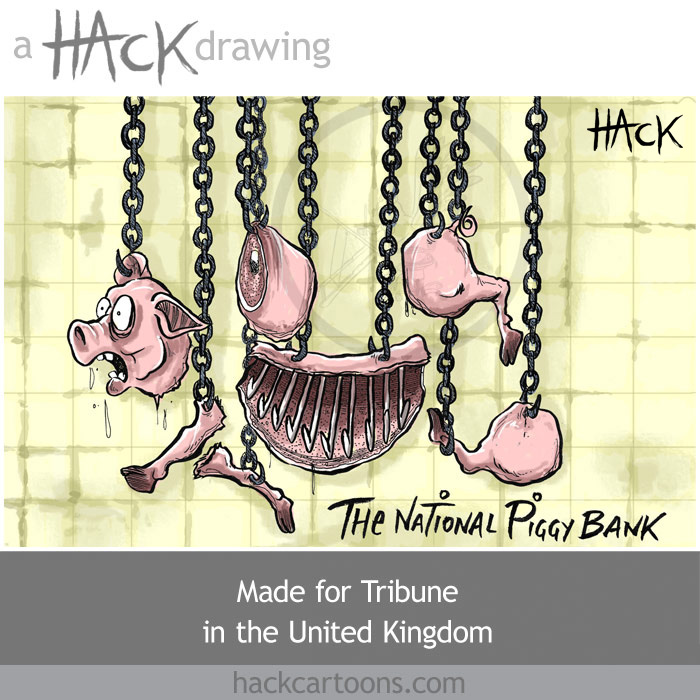
UK politicians expenses claims © Matt Buck Hack cartoons for Tribune
There is another furore about the expenses of the UKs professional politicians – and this one features the Home Secretary Jacqui Smith. As is traditional, the particulars of the matter have now been outsourced to an independent review (name that peer to run it) and then kicked hard into the long grass.
This week also saw the start of the formal withdrawal of British troops from Iraq after the 2003 invasion and subsequent occupation. There is not much clarity about the national expenses claim resulting from this although Military Families Against the War have been asking.
UPDATED: 14th May 2009. If you have arrived here after The Daily Telegraph’s revelations about the MPs allowances scandal you can find further content here, here and here.
on March 31, 2009
If you would like to reuse this drawing please ask me here. Thank you!
There has been an opening salvo to this week’s G20 from the OECD. The PM may not be too keen to read the various readings of their economic analysis for the UK. Background to who the OECD are is here and here.
on March 31, 2009
If you would like to reuse this drawing please ask me here. Thank you!

Caricature of Iain Dale, British Conservative blogger and publisher © Matt Buck Hack Cartoons
Online notoriety follows Iain Dale, the Orwell prize nominee for blogging around. There’s no word on his current business expense claims 😉 although as he publishes Total Politics magazine in print I imagine they can be quite extensive. I ought to admit a sneaking admiration for Iain’s past as owner and publisher of the Politico’s bookshop in London‘s Victoria. He ran a fine shop there which now lives entirely online, although Iain has nothing to do with it anymore.
You can choose whether he should wear the horns or the halo in the picture.
on March 30, 2009
If you would like to reuse this drawing please ask me here. Thank you!
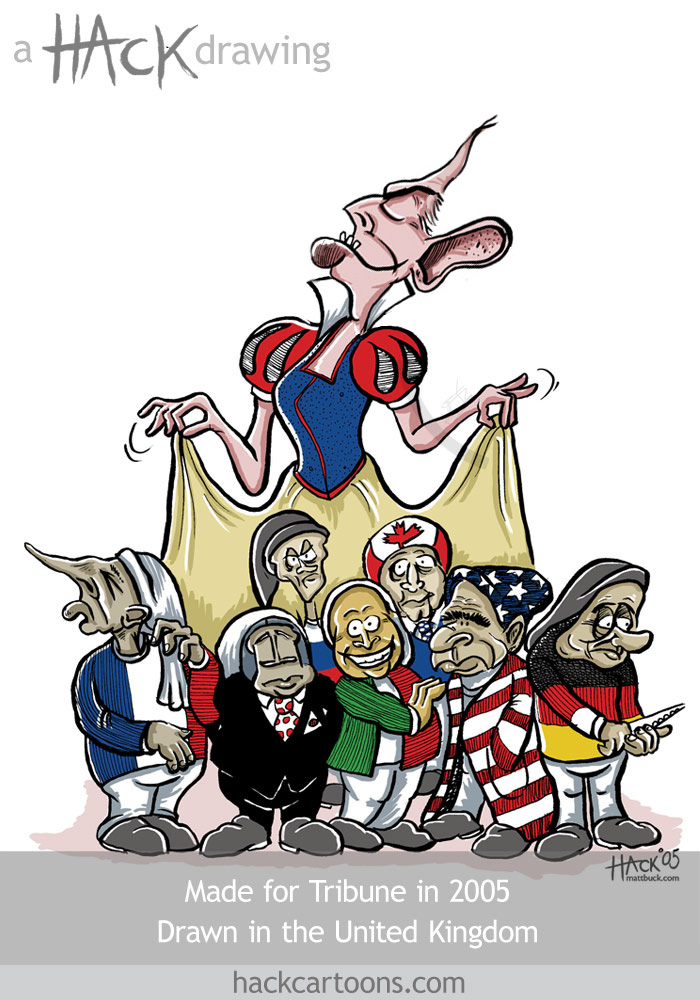
g8_g20 and global geopolitics © Matt Buck Hack Cartoons
The last time the UK hosted a meeting with as much hoopla as this week’s G20 summit was in 2005 when the G8 (as it was then) came to Gleneagles in Scotland. At the time, the political focus was on Tony Blair and Gordon Brown’s plans to ‘save’ Africa through the good works of the wealthiest nations on earth. I drew this picture at the time and the caricature of the then PM is, as one of my professional colleagues tactfully put it, pushing the edges of what is possible – ie. it’s OTT. Who said cartoonists cannot be kind.
on March 26, 2009
If you would like to reuse this drawing please ask me here. Thank you!
Notes for context from Bloomberg
on March 25, 2009
If you would like to reuse this drawing please ask me here. Thank you!
Gilts are super secure investments which fund government borrowing. They are sold, or auctioned when the country’s leaders need to raise money against the security of the UKs international credit rating.
Today it has been reported the government has not been able to sell all of its latest auction of gilts.
A failure to sell everything at a gilt auction is not good news because it implies the market of potential investors in the government’s debt, is worried about the credit worthiness of the government itself. This worry may be a result of the large financial measures the government is already taking to try and prevent the recession deepening (see blogs past). These measures are being largely funded by borrowing, financed through the sale of gilts.
The BBC’s report is here, or, get it from Tim Worstall, here.
What are gilts – from Wikipedia
How do gilts work – from the Telegraph
UPDATED: 4.20pm same day.
on March 25, 2009
If you would like to reuse this drawing please ask me here. Thank you!
In which Mervyn tries to explain what he thinks about what is happening while the Prime Minister is out of the country (report from Faisal Islam). Realists suggest the governor is carefully distancing himself from the political leadership in case of unfortunate occurences – events such as unemployment, stagnant or falling wages for work and rising prices for day-to-day items of shopping.
There’s an archive cartoon from Channel 4 News about the many interest rate cuts of last autumn, below.

Published at Channel 4 News.
on March 24, 2009
If you would like to reuse this drawing please ask me here. Thank you!

- Barack Obama US Dollar © Matt Buck Hack Cartoons
From the New York Times, Zhou Xiaochuan, governor of the People’s Bank of China, said a new global currency reserve system controlled by the International Monetary Fund could prove more stable and economically viable than the US dollar. You can read his one-page think piece here.
This is a significant thing because China has vast holdings in US dollars, which are likely to be suddenly devalued (becoming ‘worth’ less to them) because of the credit easing, (or, printing of imaginary money) which the US government is now engaged in.
It is not coincidence that this idea is being floated by the Chinese, one week before the meeting of the G20 in London. They know America is weaker now as an economic power than it has been since the end of world war 2.
UPDATED: 11.20am. The BBC report is here.
The implications of a new global currency would be the effective end of US economic hegemony as the military and economic superpower and more of a multi-polar world.
on March 23, 2009
If you would like to reuse this drawing please ask me here. Thank you!
This link more or less explains the full scale of the debt problem in the global financial crisis. The important line in Robert Peston’s report concerns the extent to which governments have ‘mortgaged’ future revenues from national taxation to prop up financial institutions now. These banks and insurance houses are the ones which have acquired vast debts and liabilities through reckless and apparently unregulated lending.