Reposted: 12th March 2009
The latest new report from Bloomberg on Bernie Madoff’s life sentence is here
Reposted: 12th March 2009
The latest new report from Bloomberg on Bernie Madoff’s life sentence is here
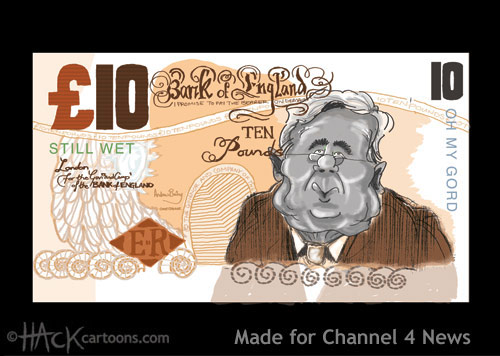
Bank of England Pound note featuring Governor of the BoE Mervyn King © Matt Buck Hack Cartoons
Today the government of the UK and the Bank of England will start buying assets from themselves using imaginary, or invented, money.
The definition of quantitative easing below is from Wikipedia.
In very simple layman’s terms, the central bank creates new money out of thin air. It then uses this money to buy what is essentially an IOU, usually from the government. This money is credited to the bank account of the seller of the IOU. The bank can then use this money as a basis for creating more new money by increased lending.
There is an explanatory graphic available here from Faisal Islam at Channel 4 News and Robert Peston of the BBC muses on the possible consequences of all this here.
In an effort to avoid becoming a dying industry the Guardian news organisation has done something quite radical.
UPDATED 1pm 10th March 2009: Although, at the same time in a.nother part of the same media group there are some redundancies. (via)
UPDATED UPDATE 6pm: Press statement on the job losses from Guardian Media Group. (Via
AND AGAIN: Noon on 11th March 2009: Martin Belam at CurryBet.net on the launch of Open Platform
AND: 4pm 11th March 2009: Jon Slattery has more on further job losses at GMG newspapers
AND: 12th March 2009: An interesting point illustrating the problems established media have had with the digital world. Kudos to Paul Bradshaw and Malcolm Coles.

Dying Industries cartoon - Coal mining and City of London financial services © Matt Buck Hack Cartoons. Drawing as a cover cartoon for Tribune magazine in the UK
It is 25 years since the last great industrial dispute in Britain – the year long Miners’ Strike of 1984. The collapse of the strike in spring 1985 effectively settled the argument about future energy provision in the UK with the eclipse of the coal industry and the start of the ‘dash for gas’ from supplies and suppliers in the North Sea and on continental Europe. The majority of the UK’s existing mining industry was wound down and closed in the following decade, although a rump industry survives.
You wonder if something similar isn’t now happening to financial services. We have discovered that much of our apparent national wealth was largely based on foreign-owned financial resources being taken into and out of the City of London. That resource has vanished in the global financial crisis and the government is now trying to fill the enormous black holes which have opened in our accounts as a result.
In among the murk, it is clear the City of London is going to very much less powerful than it has been. It’s all rather like the end of the old mining industry.
An aside, the excellent photographer Martin Shakeshaft has a fine collection of reportage images from the strike of Miners’ Strike of 1984 available here.

Alastair Darling cartoon © Matt Buck Hack cartoons
The government finally took a majority stake (65%) in the Lloyds Banking Group* over the weekend. In doing so it offered the same sort of ‘insurance’ deal for the bad loans and large debts which the bank has accumulated. The national taxpayer exposure to these debts is around £250bn.
The political chatter around this focuses on executive bonuses and the blame game among the politicians and the executives of the institutions, rather than on the liability which the nation is now carrying for the bank.
There’s a piece of period Lloyds advertising from the mid 1980s here. If you watch, you’ll see the effects of Mrs Thatcher’s financial deregulation legislation which was the political and economic fashion of the time. The advert shows the bank was starting to sell and tie in other financial products to its core retail banking business.
In some respects, the national problems we have now are a result of this growth of ‘old-style’ retail banking into areas of business, and into the selling of financial products, which were not well understood.
* Formerly Lloyds Bank and Halifax Bank of Scotland
…about the slump from the BBC.
Here is a clip from Channel 4 News on 5th March 2009 explaining what quantitative easing means for the UK. I got to invent the imaginary paper money for the show which was a lot of fun. I read recently that what some people call ‘doodling’ is very good for concentration and memory, I hope it helps Mervyn King and the the people who are trying to manage what’s left of the UKs economy. The scale of what was announced yesterday is enormous and its effects will last a long time for all of us. The Governor of the Bank of England and the government argue that increasing the money supply to the national economy by inventing money is possible because interest rates and inflation (price rises) are low, but, as this link explains, this is not-quite-the-truth about inflation on items we all have to buy regularly.
There are some links here to more clips from Channel 4 News featuring Jon Snow interviewing a variety of the great and the good, including Sir Howard Davies and Will Hutton, all with the bizarre (but great) sight of my caricatures peering over their shoulders.
The presentation on screen is a credit to the studio manager who put it all together, mind you, I’m biased.

Gordon Browner, or the imaginary ten pound note (Gordon Brown Tenner) © Matt Buck Hack Cartoons. Made for Channel 4 News in the UK
A busy day making dodgy cash for television production folk.
…on behalf of HM government
A non-cricket cartoon made for Channel 4 News in 2007.