…may no longer be acceptable in the UK, thanks to Section 76 of the Counter Terrorism Act of 2008. However, here are some happy, cheerful (and daily) snaps of places in which police people have been inadvertently immortalised by folk with cameras. Spread the word, some of the photographs of offices, shops and buildings are really fine. I am fond of the Sushi bar one.
AIG – the business insurer’s insurer has announced the largest loss in US business history – $61.7bn or, about £43bn. Their business has been insuring the loans and business dealings of global enterprises, many of whom, we are discovering, are basically bankrupt. AIG are also the shirts sponsors of Manchester United, current club football champions of England, Europe and the World and who yesterday won the Carling Cup. Their name is often shortened to…

AIG and Manchester United cartoon © Matt Buck Hack Cartoons
Unsurprisingly, the AIG sponsorship deal with United will not be being renewed. There’s a lively scrap though for who will get the honour as Paddy Power reports…

© Matt Buck Hack Cartoons for Computng
Read Chris Dillow on the Fred Goodwin smokescreen and several other things
As usual, the face of Sir Fred Goodwin, the Enemy of the People, had flashed on to the screen. There were hisses here and there among the audience. The little sandy-haired woman gave a squeak of mingled fear and disgust. Goodwin was the renegade and backslider who once, long ago (how long ago, nobody quite remembered), had been one of the leading figures of the economy, almost on a level with the Prime Minister himself, and then had engaged in counter-economic activities, had been condemned to be pilloried, and had mysteriously escaped and disappeared.
Sir Fred Goodwin has a legal contract of employment and he is entitled to the rewards he negotiated, whether the system should have allowed that sort of contract to be negotiated is a.nother question.
Quote from Eric Blair and George Orwell in 1984.
[flash https://hackcartoonsdiary.com/wp-content/uploads/2009/02/TR_ED_plummet_260209.swf w=500]
Some words in a rhythm; Chancellor,iron, Services Authority, Financial, Bank of Scotland, Royal, Brown,Gordon, crime,white-collar, soaring values, shared,thin air, money out of.
One of today’s many revelations is the rise in the taxpayers stake in RBS – to 80% ownership – the Reuters story linked at the bottom of this piece, gives the Chancellor, Alistair Darling’s, explanation. This is effective nationalisation of RBS but the government is still clearly anxious to avoid taking all of its debts and liabilities onto the national balance sheet. This continued reluctance gives an idea of the scale of these operations, as 20% of what RBS used to be worth is still a mind-bogglingly enormous sum of…
Actually, what the sum is made of is an interesting question and these links may help explain some of it. One important thing to remember if you explore these, is that money is about trust and basic human psychology (the link under help is very good) and this is important when you consider debt, or, imaginary money.
Some of the consequences of the collapse in value of RBS’s ‘money’ are explained by Sam Jones at FT Alphaville who has a fisking of this morning’s announcements here.
In essence, the ‘insurance guarantee’ the UK taxpayer is now giving to RBS means that we are now both helping to fund the banks ongoing operations and guaranteeing their existing, and perhaps future, trading losses of whatever it is.
From the UK; BBC report, Telegraph report, Guardian report, Reuters report, AP report and Bloomberg on Sir Fred Goodwin’s pension.
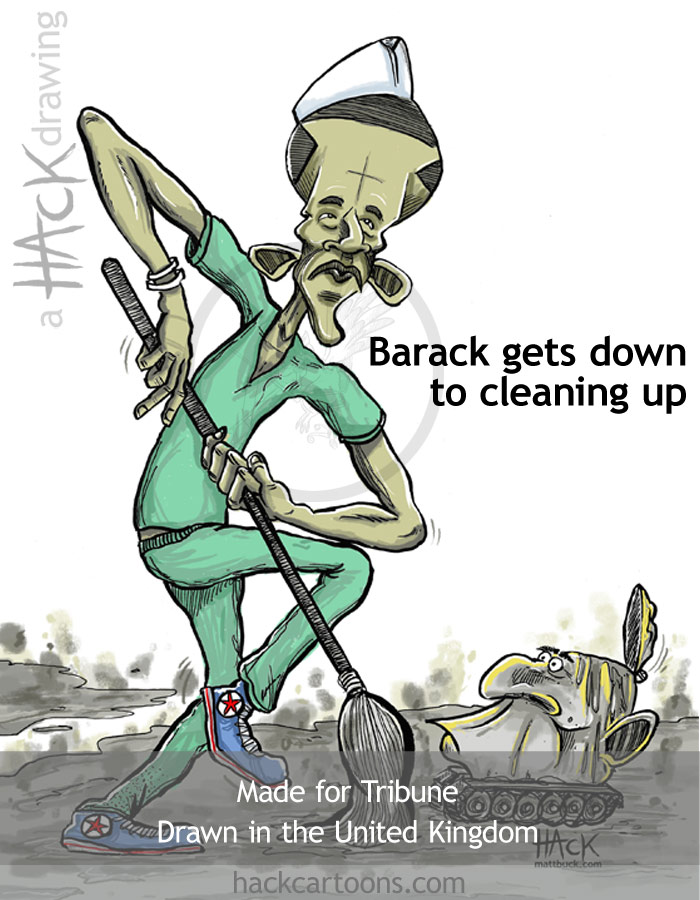
Barack Obama cartoon for Tribune magazine cover image. © Matt Buck Hack Cartoons. Drawn in the UK.
President Obama continued his word-led clean up of US political discourse yesterday in a speech to the US Congress. He’s gathered some early criticism for his tendency to speak bluntly about the size of the economic challenges facing America, but after the eight years of the half-truths, evasions and outright lies told by his predecessor perhaps that is not so surprising.
US correspondent Toby Harnden reported it live.
And the edited highlights package below is from AP.

Recession, job losses and hard times in journalism cartoon © Matt Buck Hack Cartoons
Kudos to Paul Murphy at the FT’s excellent Alphaville blog for spotting one of the more amusing examples of don’t-mention-the-economic-war.
The scene, the London School of Economics and a debate on journalists’ reporting of the financial crisis. The implicit questions (my emphasis), whether reporters should be allowed to ask awkward questions* to those in power during difficult times and, whether journalists are actually able to do this. The second question relates to the the size and power of the financial industry’s public relations operations compared to the resources of commercial or even state-funded journalism.
On stage at the event were reporters Evan Davis and Robert Peston of the BBC, Alex Brummer of the Daily Mail, Gillian Tett of the FT as well as Lib-Dem MP Vince Cable, and economist Willem Buiter. In the moderators chair and keeping an expert eye on proceedings, Sir Howard Davies, head of the LSE itself.
Hang on. Could that be the same Howard Davies who was the first head of the Financial Services Authority in the UK, appointed in the time of the iron chancellor Gordon Brown? Why! It could.
Shouldn’t a man like that, who has also been a recent Deputy Governor of the Bank of England, have been answering questions from the reporters instead of presiding over an analysis of the relatively powerless scribblers and their activities?
Charlie Beckett has a match report and journalism.co.uk, analyses events here too. I am looking forward to hearing the post game punditry from Howard Davies.
* ie. straight ones.
Via the well-briefed Mr Robert Peston of the BBC. It appears the Government and the banks believe the national taxpayer must insure the bad debt, or losses of the Royal Bank of Scotland (RBS) and the Lloyds Banking Group (the latter, including Halifax Bank of Scotland HBOS). It seems this amount to be ‘guaranteed’ is estimated at £500bn – or, half of one trillion pounds.
The US Central Intelligence Agency publishes a World Fact Book and estimated UK GDP, or Gross Domestic Product, during 2008 as $2.27tr (Trillion). This converts to, approximately, £1.56tr (Trillion).
Of course, this new guarantee of £500bn, (or £0.50tr) has to be added to the money from government which has already been provided for the insolvent banks. Peston’s reported estimate of this total sum is about £1.5tr.